GenAI vs agentic AI
A layered explanation of where content generation ends and autonomous execution begins.
The cleanest distinction
IBM frames generative AI as the layer that creates original content in response to prompts, while agentic AI is the layer that can autonomously make decisions, plan, and act with limited supervision.
That is the distinction this page uses too: gen AI reacts, agents execute tasks with tools, and agentic systems coordinate goals, plans, monitoring, and adaptation.
Reading the supplied diagram
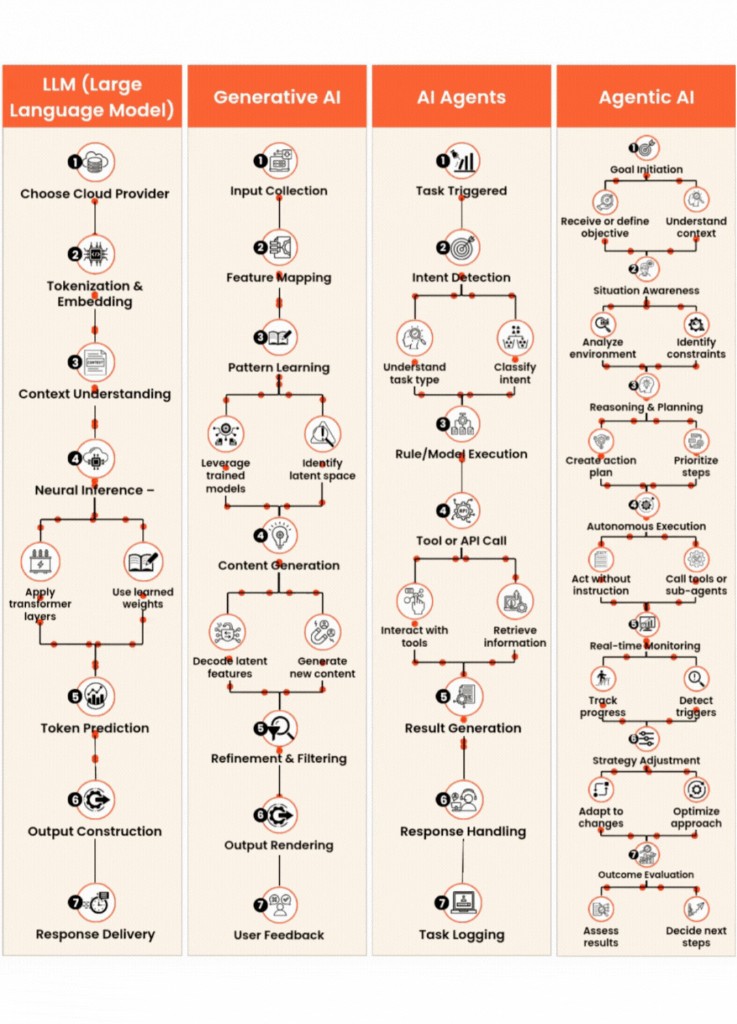
The comparison graphic is useful because it separates the stack into four increasingly capable layers rather than collapsing everything into one buzzword.
- LLMs: tokenization, context understanding, transformer inference, token prediction, and response delivery.
- Generative AI: input collection, feature mapping, pattern learning, content generation, refinement, and user feedback.
- AI agents: task triggers, intent detection, rule or model execution, tool or API calls, result generation, and task logging.
- Agentic AI: goal initiation, situational analysis, reasoning and planning, autonomous execution, monitoring, strategy adjustment, and outcome evaluation.
Why people mix them together
In practice, products often layer all four. A single tool can use an LLM for language, a generative interface for output, agent behavior for tool calls, and agentic orchestration for longer loops.
The Reddit discussion around this graphic is useful because it reflects the same intuition many practitioners have: the terms describe different operating layers, not four mutually exclusive product categories.
Agentic AI is focused on decisions as opposed to creating the actual new content, and does not solely rely on human prompts nor require human oversight.
IBM: Agentic AI vs. generative AI
A working editorial model
When a system stops at content generation, it is usually still generative AI even if the output is sophisticated.
When it can interpret intent, call tools, and return a result, it begins to act like an agent.
When it can accept a goal, decompose work, monitor state, adjust strategy, and continue without fresh prompting every step, the 'agentic' label becomes more defensible.