Current systems brief
Agentic AI vs GenAI
A deeper 2026 guide to where generative AI ends, where AI agents begin, and when agentic systems are worth the operational overhead.
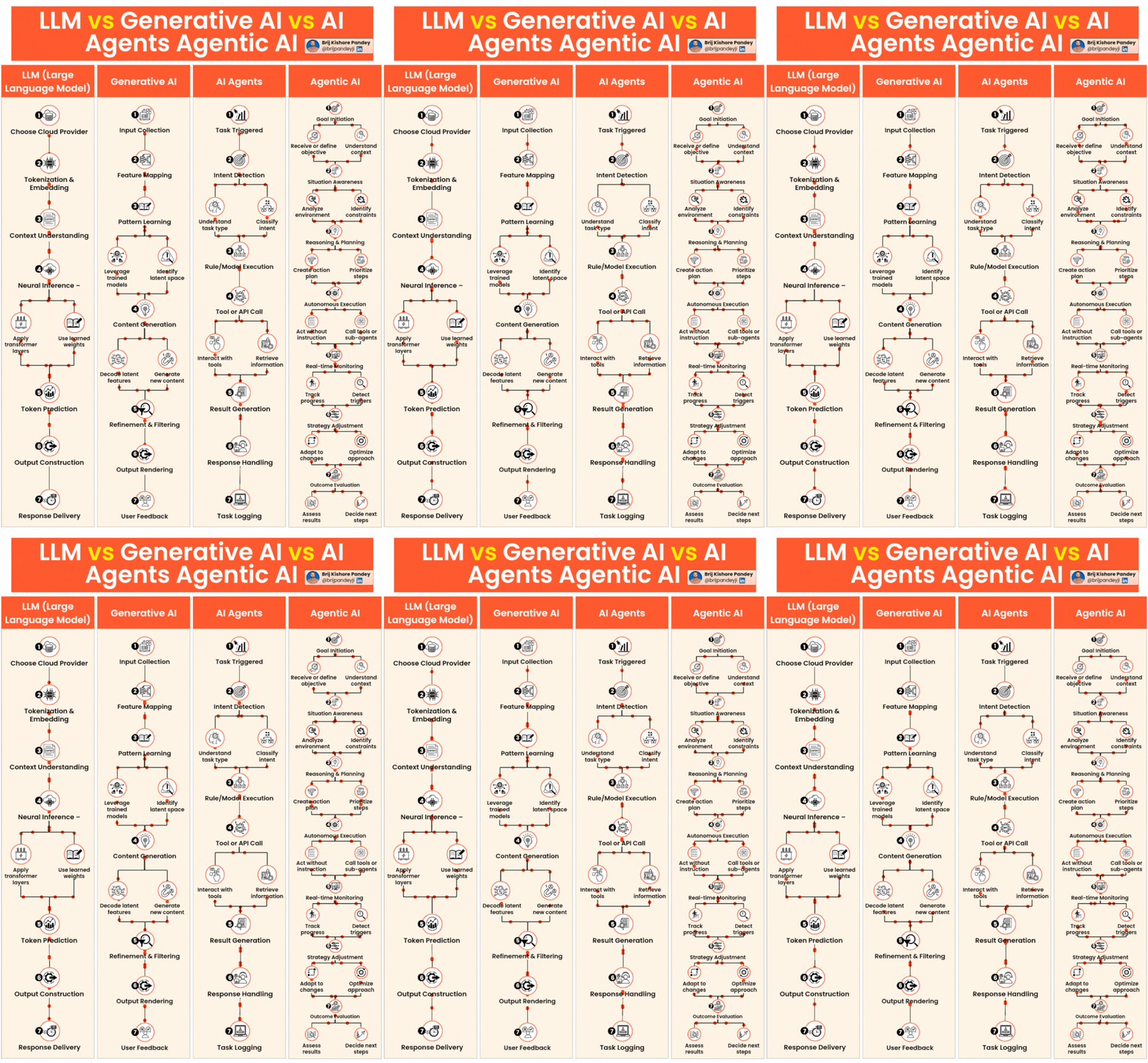
Agentic AI vs GenAI: what is the actual difference?
The simplest honest answer is that GenAI creates, while agentic AI acts. Generative AI systems are designed to produce text, code, images, audio, or summaries from a prompt and a context window. Agentic systems are designed to pursue a goal, which means they often need memory, planning, tool access, permissions, policy checks, and some ability to revise the plan when the first attempt fails.
That is why the strongest current explainers no longer treat the distinction as a branding exercise. AWS, Red Hat, Infor, and Thomson Reuters all frame the difference in operational terms: generation is about producing an output, while agentic behavior is about carrying work across multiple steps and systems.
In practice, most useful products combine both. A frontier model still handles language, reasoning, and synthesis. The agent layer wraps that model with state, tools, retrieval, monitoring, and decision rules. That wrapper is what turns a good answer into a workflow that can actually do something.
The stack people still collapse into one buzzword
The top posts are most useful when they stop arguing about terminology and start separating system layers.
| Layer | Primary job | What it is good at | Why it fails |
|---|---|---|---|
| LLM | Predict tokens from context | Language, pattern compression, reasoning, drafting | No durable state, no native accountability, no action model by itself |
| GenAI application | Generate a useful artifact for a human | Writing, summarizing, coding help, image generation, analysis drafts | Stops after the answer; execution still belongs to the user |
| AI agent | Use tools to finish a bounded task | Fetching data, filling forms, updating systems, handling a workflow | Brittle tool use, weak recovery, permission mistakes |
| Agentic system | Pursue a goal across multiple steps and adjust the plan | Longer-running workflows with monitoring, checkpoints, and recovery | Unsafe autonomy, opaque decisions, governance and observability gaps |
Generative AI, copilots, AI agents, and agentic AI are not the same product category
A lot of current search traffic mixes together four different product shapes. A plain generative AI tool answers or creates. A copilot helps a human finish work. An AI agent can use tools to complete a bounded task. An agentic system goes further by maintaining state, deciding among next actions, escalating when needed, and pursuing the goal until it is either complete or blocked.
That distinction matters because buyers often think they are shopping for one thing when they are really moving between categories with very different safety, engineering, and procurement implications. The moment an AI product can log into systems, modify records, trigger workflows, or take action across software boundaries, the discussion is no longer just about prompt quality.
Where serious explainers converge
The strongest explainers are more aligned than the hype makes it seem. AWS and Red Hat both draw the same core line: GenAI is strongest when the product is the output itself, while agentic systems are strongest when the product is completed work. Infor adds the enterprise framing that matters most to operators: the jump from generation to action is not cosmetic, because the system suddenly needs to coordinate with business software, policy rules, and exception paths.
Thomson Reuters is useful because it adds a market read, not just an architecture read. Its 2026 professional-services reporting says organization-wide AI use is now widespread and that many firms are already preparing for the next wave of tools, including agentic AI. That matters because it suggests the market is moving from experimentation with prompts toward workflow automation with accountability.
AP News remains valuable as a corrective. It treats 'agentic' as partly real progress and partly marketing inflation. That is the right stance. The phrase becomes meaningful only when the system can inspect state, choose actions, handle intermediate failure, and operate inside explicit human and policy boundaries.
How the use cases split
The right choice depends on whether the output is the value or whether completed work is the value.
| Use case | GenAI-first pattern | Agentic pattern | Why the distinction matters |
|---|---|---|---|
| Research and summarization | Generate briefs, summaries, citations, and first-pass analysis | Plan searches, gather sources, compare evidence, and assemble a deliverable with checkpoints | Generation helps thinking; agentic systems help execution across steps |
| Customer support | Draft responses and surface likely answers to a human | Triage tickets, look up account state, trigger follow-ups, and escalate edge cases | The operational risk rises sharply once the system can change customer state |
| Finance and operations | Draft reports or explain anomalies | Collect inputs, reconcile records, route approvals, and log outcomes | Completed workflow matters more than writing quality |
| Security and IT | Summarize alerts or explain incidents | Investigate, correlate, propose actions, and execute approved playbooks | Observability and rollback become part of the product |
| Software delivery | Generate code, tests, docs, or explanations | Inspect a codebase, edit files, run tools, verify results, and recover from failure | This is where agent quality is judged by safe completion rather than clever text |
What changes operationally when you move from GenAI to agentic systems
This is where the top posts get serious. The technical problem changes the moment an AI system can create side effects in live tools.
| Dimension | GenAI pattern | Agentic pattern | New requirement |
|---|---|---|---|
| Output | Answer, draft, recommendation, code snippet | Completed task, transaction, state change, escalation | Verification before or after execution |
| Context | Single prompt plus attached data | Persistent state across steps | Memory and state management |
| Control | Human reviews the result | System can initiate actions | Permissions, policy, identity, and approval checkpoints |
| Reliability | Mostly judged by answer quality | Judged by completion quality and safe recovery | Observability, retries, rollback, and audit logs |
| Risk | Hallucinated content or weak analysis | Bad actions in real systems | Guardrails, sandboxing, and human override |
Where GenAI is still the better answer
A large amount of current AI demand is still better served by GenAI than by agentic AI. Drafting marketing copy, summarizing research, generating first-pass code, preparing sales notes, extracting document insights, or producing image variants are all classic generation problems. The user wants speed, quality, and controllability, not autonomy.
This is where teams overbuild. They take a prompt-and-response use case and force it into an agentic frame because the category sounds more advanced. In most of those cases, a strong model plus retrieval, templates, and light human review is safer, cheaper, and easier to explain.
When agentic AI actually earns its complexity
The best current writing is conservative here. Agentic systems are justified when the work really needs closed-loop execution rather than better text generation.
- Multi-step operational work where the system must gather evidence, call tools, update records, and verify completion.
- Cases where the bottleneck is not writing or summarizing, but coordinating actions across multiple systems.
- Workflows with explicit checkpoints, escalation rules, and recoverable failure states.
- Environments where an audit trail matters because the system touches customer operations, finance, support, compliance, or security.
Why governance, identity, and observability dominate the serious writing
Once a system can act, the center of gravity shifts from prompt engineering to control architecture. That is why the most valuable current sources lean hard on governance and security. Thomson Reuters' governance writing, Microsoft's observability warnings, and current architecture research all keep returning to the same point: if an AI agent can trigger side effects, you need to know what it attempted, what it touched, what it decided, and how a human can intervene.
This is not bureaucracy. It is the minimum viable safety model for autonomy. Identity management, least-privilege permissions, sandboxed tools, replayable logs, approval gates, and adversarial testing are not optional decorations around agentic AI. They are the actual product requirements.
The newest signal is capacity, not just cleverness
The next phase of agentic AI is also an infrastructure story. Better autonomy needs longer runs, more tool calls, larger context windows, more verification passes, and enough inference capacity that users are not constantly shaped by rate-limit anxiety.
That is why Anthropic's new SpaceX compute agreement matters for the category. The immediate point is higher Claude Code and Opus API limits, but the strategic point is larger: frontier agents are becoming a compute-supply business. If agentic systems are going to inspect codebases, operate software, read dense screenshots, call tools, and recover from failures, model quality and available compute have to improve together. Anthropic's orbital-compute language is still forward-looking, but the positioning is clear: AI agents are being sold as long-running work systems, not just smarter chat windows.
A practical adoption sequence
The responsible rollout path is usually incremental rather than theatrical.
- Start with GenAI for drafting, retrieval, summarization, and decision support where a human remains the final actor.
- Add bounded tool use for tasks where the system can retrieve or update information under clear permissions.
- Introduce approval checkpoints before any irreversible action, customer-visible change, or sensitive system write.
- Expand autonomy only after the system has logs, metrics, failure handling, and an operator who can explain what happened.
The rollout pattern that keeps making sense in 2026
The strongest pattern is not 'turn the model into an autonomous employee.' It is narrower. Start with GenAI for understanding, drafting, and summarization. Add tools for bounded execution. Keep a human in the loop for approval, exception handling, or irreversible steps. Only then expand autonomy where the workflow is repetitive enough to justify the governance burden.
That sequence shows up again and again because it respects how brittle agentic systems still are. Reliability improves when autonomy is earned step by step instead of declared in a product launch.
Frequently asked questions
These are the practical questions people usually mean when they search agentic AI vs GenAI.
Is agentic AI just a new name for AI agents?
Not exactly. AI agents usually refers to systems that can use tools to complete a task. Agentic AI usually implies a broader loop of goal setting, planning, execution, monitoring, and adaptation across multiple steps.
Is GenAI part of agentic AI?
Usually yes. In most modern stacks, a generative model is the reasoning and language engine inside a larger agentic system. GenAI does the thinking and drafting; the agentic layer handles memory, policies, tools, and execution.
When should a business stick with GenAI instead of building an agentic system?
Stick with GenAI when the main job is still content generation, summarization, explanation, or analysis for a human reviewer. Move to agentic systems only when the value comes from actually completing bounded work across systems.
What makes agentic AI different from an AI copilot?
A copilot primarily assists a human user inside the user's workflow. Agentic AI is closer to a system that can own part of the workflow itself: inspecting state, calling tools, deciding next actions, and moving work forward under rules and supervision.
What is the biggest mistake in agentic AI projects?
Treating autonomy as the feature instead of safe completion. Teams often overestimate how much freedom an agent should have and underestimate the need for permissions, observability, and rollback paths.
Bottom line
GenAI is still the right default when the output is the product.
Agentic AI becomes real when the system can carry work across steps, use tools, and change state in other systems.
That jump can create major business value, but it also creates a much more serious engineering, governance, and security problem. That is the real difference.
Visual source gallery
These are the current sources behind this page as of 2026. The extra depth here comes from combining architecture explainers, governance writing, current reporting, and safety-oriented operational guidance rather than repeating one definition five different ways.
Useful because it cleanly separates content generation from goal-directed action and ties agentic systems to policies, tools, and auditability.

Strong on the technical distinction between using context to create and using context to decide and act.
Adds market context: GenAI is now mainstream in many professional environments and agentic systems are part of the next planning wave.

One of the clearest references on why autonomy raises the governance and cybersecurity burden.

Helpful on enterprise framing: the moment agents touch live business systems, process design and controls matter as much as model quality.
Important counterweight because it treats the term as partly real progress and partly marketing inflation.
Provides the architecture lens: agentic systems are iterative control loops, not just chatbots with tool calls.
Adds the operational warning many explainers skip: once systems can act, identity, observability, and human override stop being optional.
Important current market signal: agentic AI is constrained by inference capacity, not only model cleverness. Anthropic ties higher Claude Code and Opus API limits directly to new compute supply.
Useful adjacent reading on moving from language output to controlled workflow automation, tool access, and measurable business process changes.